Time Is the Real Luxury
For those who fly private, time is rarely casual. It is allocated, measured, and protected. Private aviation transportation exists for this reason. It ensures that the discipline created in the air is not lost the moment the wheels touch the runway.
Flying private removes lines, terminals, and delays inside the airport. Yet the experience can still fragment on the ground. A vehicle that is late. A driver navigating uncertainty. A route that fails to anticipate traffic. Private aviation transportation is the bridge between aircraft and city, and it must operate with the same precision as the flight itself.
Clients who value time above all understand this instinctively. The transition from jet to destination should feel direct, composed, and uninterrupted. Private aviation transportation is not an accessory to private flight. It is the continuation of it.
Where Precision Is Expected, Not Requested
Clients who fly private do not ask for efficiency. They assume it.
The aircraft is ready when they arrive. The cabin is prepared. The schedule bends around their commitments, not the other way around. That standard creates a rhythm. And once that rhythm is established, anything slower feels disruptive.
This is where private aviation transportation carries weight. The transition from jet to city must feel immediate, not arranged. The vehicle should already be positioned. The route already considered. The chauffeur already briefed.
Private aviation transportation in this environment is not about hospitality gestures. It is about precision under pressure. When a landing time adjusts or a departure window tightens, the ground response must adjust without visible strain.
Private aviation transportation succeeds when it feels instinctive. When there is no hesitation between aircraft and movement. When the city is entered with the same control that defined the flight.
At this level, precision is not a request. It is the expectation.
The Hidden Time Loss Between Jet and City
The most expensive delay is often the smallest one. Five minutes waiting at the curb. Ten minutes navigating the wrong exit. Fifteen minutes caught in avoidable congestion. Individually, these moments seem minor. Collectively, they erode the efficiency that private flight was designed to protect.
Private airport car service should not feel improvised. It should be pre-structured. Arrival times monitored. Vehicle positioning confirmed. Routes adjusted in real time. Private airport transportation must account for traffic shifts, security perimeters, and event-related congestion before the client ever sees them.
For clients moving directly into investor meetings, production schedules, or personal commitments, time sensitivity is not theoretical. It shapes the entire day. Private aviation transportation protects that momentum by removing unnecessary pauses between jet and destination.
When executed properly, the transition feels immediate. The aircraft lands. The vehicle is present. The route is clear. Movement continues.
How REL Structures Private Aviation Transportation Around Time
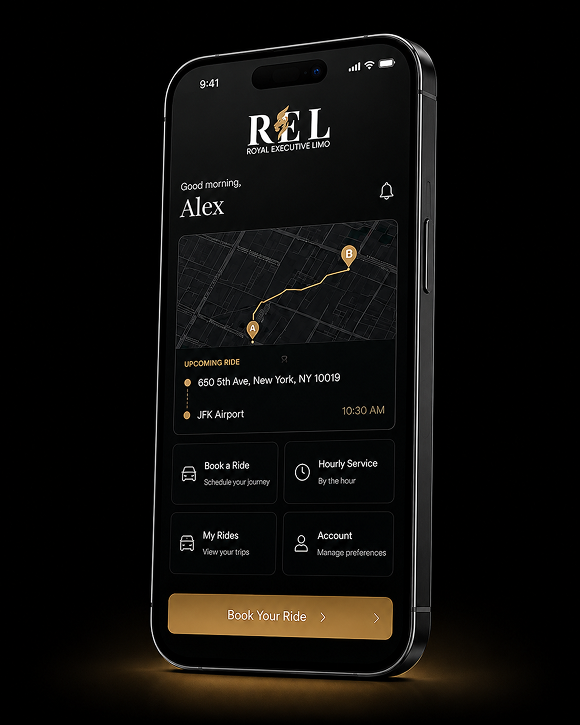
At REL, private aviation transportation is coordinated long before the aircraft approaches descent. Arrival windows are monitored. FBO procedures are reviewed. Vehicle positioning is confirmed with precision. The objective is simple: eliminate uncertainty at the moment of arrival.
Executive airport transfer planning begins with understanding the schedule beyond the runway. Is the client proceeding directly to a board meeting? A studio appearance? A private residence? Each scenario influences routing, timing, and vehicle selection.
Private aviation transportation at REL is not reactive. It is structured. Chauffeurs are briefed on terminal access points and instructed on discretion protocols. Vehicles are staged to minimize visibility and maximize efficiency. The departure from the FBO is designed to feel immediate and composed.
For clients who frequently rely on private airport transportation, consistency becomes critical. The experience at Van Nuys should mirror the experience at HPN. The transition from aircraft to city should feel uniform, regardless of geography.
Private aviation transportation also integrates seamlessly with broader executive airport transfer needs when travel extends beyond a single city. Continuity across airports, offices, and residences ensures that time remains protected throughout the itinerary.
This is not about visible luxury. It is about disciplined execution. Private aviation transportation, when structured properly, preserves the advantage that private flight was intended to provide.
When Minutes Carry Meaning
For many private flyers, schedules are layered and unforgiving. A negotiation may begin shortly after landing. A media appearance may be timed precisely. A family commitment may follow an already compressed travel window. In these situations, minutes carry consequence.
Private aviation transportation becomes a strategic safeguard. It removes hesitation from the transition. It ensures that arrival is not followed by recalibration. There is no mental energy spent confirming routes or tracking vehicle location. The process feels assured.
Time sensitivity also intersects with discretion. Clients who fly private often do so to maintain control over exposure. A composed departure from the FBO and an immediate transition into the city preserve that privacy. Private aviation transportation supports both timing and discretion without drawing attention to itself.
The value is not dramatic. It is subtle. It is found in the absence of delay and the absence of uncertainty. When the ground experience is managed with the same precision as the flight, the day continues without disruption.
When Private Flight Is About Speed, the Ground Cannot Be Casual
There is a reason clients choose private aviation. It is rarely about indulgence. It is about control over time. A departure moved forward by thirty minutes. A landing adjusted to accommodate a late meeting. A return flight scheduled the moment a deal closes. The flexibility in the air is intentional.
Private aviation transportation must match that elasticity. If the ground segment is rigid while the flight is dynamic, the advantage is lost. Schedules shift in real time. Weather changes routing. Meetings conclude earlier than expected. A service built around static assumptions cannot support a fluid itinerary.
This is where disciplined private aviation transportation becomes essential. Real-time monitoring allows vehicles to reposition before arrival, not after. Chauffeurs adjust routes based on evolving traffic conditions, not outdated projections. Communication remains direct and minimal, because clarity reduces delay.
For clients who operate in compressed timelines, the transition from jet to city is not an afterthought. It is the final segment of a tightly controlled sequence. Private aviation transportation ensures that the efficiency gained in the air is not surrendered on the ground.
When speed matters, the ground cannot afford improvisation.
Beyond Convenience: Protecting Decision-Making Energy
Time is measurable. Energy is not. Yet for executives, investors, and high-profile individuals, cognitive energy is as valuable as minutes.
After a private flight, attention is already allocated to what comes next. Strategy. Negotiation. Public appearance. Personal commitments. Private aviation transportation should reduce cognitive load, not add to it.
When the vehicle is positioned precisely, when routing is verified in advance, and when transitions are executed without interruption, the client’s focus remains intact. There is no mental diversion toward logistics. No recalibration. No unnecessary messaging to confirm arrival.
Private aviation transportation protects more than schedules. It protects readiness. The environment inside the vehicle becomes controlled and quiet, allowing preparation for the next engagement. This matters especially when the ground segment immediately precedes a critical meeting or public appearance.
True private aviation transportation is not defined by luxury materials or visible branding. It is defined by the absence of friction. The arrival feels seamless because the complexity has already been managed.
And in executive environments, protecting mental clarity is often as important as protecting time.
Discretion Without Delay
Flying private is inherently discreet. Ground movement must uphold that standard. Private aviation transportation should avoid congestion, avoid unnecessary visibility, and avoid extended curbside presence.
A vehicle positioned too early draws attention. Positioned too late, it creates pause. The balance lies in precision. Private airport transportation that is structured around real-time oversight ensures that arrival and departure feel immediate yet controlled.
For clients who move frequently between cities, consistency matters as much as speed. Private aviation transportation must deliver both. The tone should remain understated. The transition should feel effortless.
The most effective service is the one that goes unnoticed. Doors open at the right moment. Routes are direct. Communication is measured. There is no spectacle, only efficiency.
Time Protected From Runway to Destination
Private aviation sets a standard. It signals that time is valuable and control is essential. Private aviation transportation extends that standard beyond the runway.
From FBO exit to final destination, the objective remains the same: preserve momentum. Eliminate avoidable pauses. Maintain composure. Ensure that arrival feels as intentional as departure.
For clients who value time above all, private aviation transportation is not a luxury. It is the continuation of discipline on the ground. And when managed correctly, it ensures that every minute between aircraft and city remains protected.